


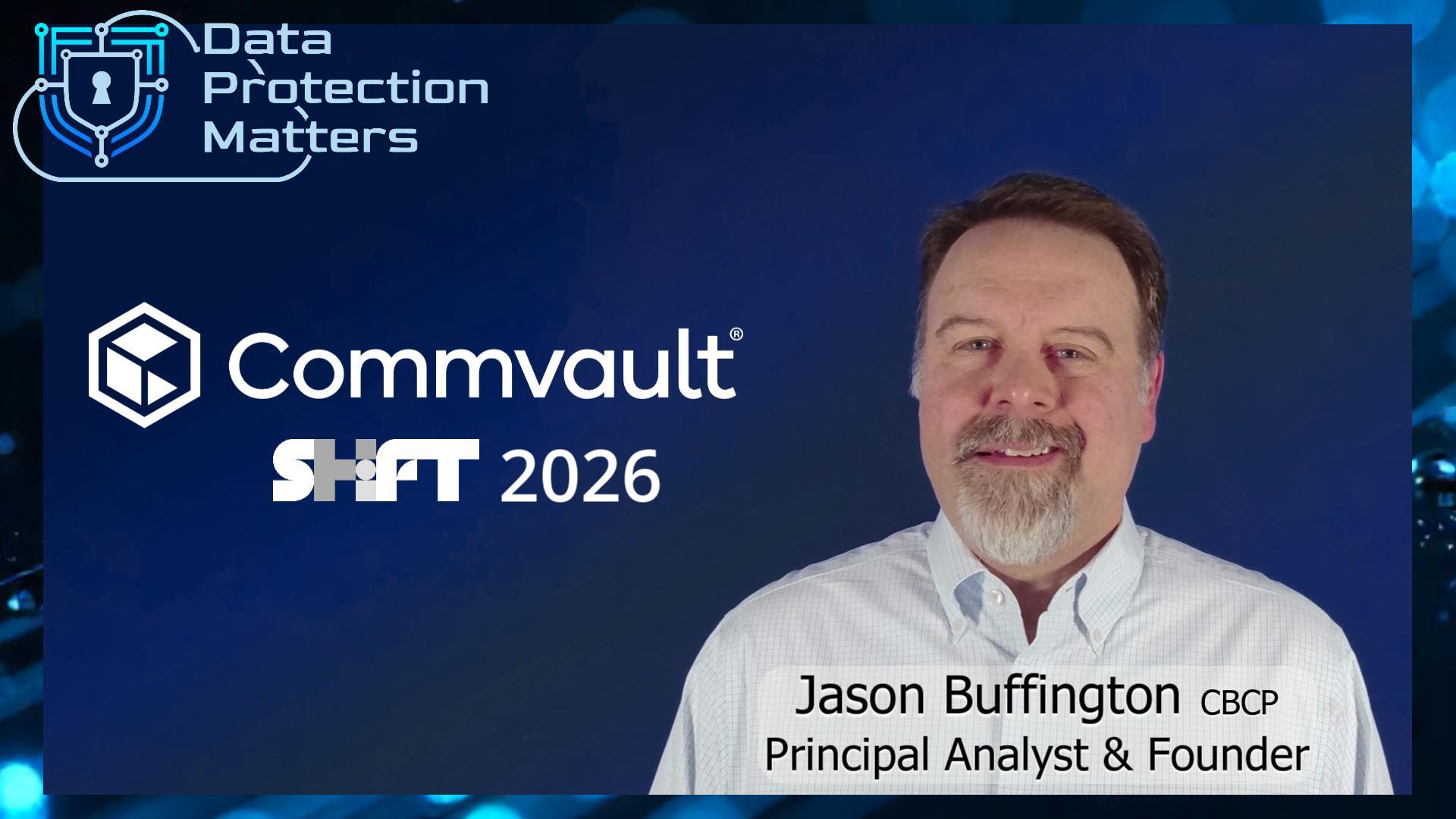
At the first Commvault GO in 2016, the message was “the power of the index.” A decade later at SHIFT 2026, we saw that vision evolved and expanded: data context, AI and infrastructure context, and, most critically, business context. Here’s some of what excites us about Commvault heading into 2027.
video transcript
To really be IT resilient, you need at least three things:
- Orchestration across the myriad scenarios that need to be durable and/or rolled back
- Context, at both a business and a technical level
- A strategy and culture that embraces continuous improvement and diligence across a range of personas
I just got back from Commvault SHIFT, so let’s unpack those three.
On strategy and culture, Commvault coined the term “ResOps,” which I’m digging into in a LinkedIn article (linked below). On orchestration, regular viewers know I believe ‘Orchestration is the superpower that determines an organization’s ability to be resilient’. Commvault announced Recovery Studio last week; it heads to early access in December, so I’m hoping to do a proper spotlight after some hands-on time.
Which brings us to context…
Now that the world has AI, data context is more attainable than ever; but this isn’t a new story for Commvault. A decade ago, back when Commvault’s event was GO instead of SHIFT, Bob and Al were on the main stage talking about ‘The power of the index’. I remember great 1:1s with them on the shared belief that the more you understood the information inside the data you were backing up, the better your backups, and your readiness to recover, would be. That seems pretty obvious in 2026; but in 2016, a lot of folks heard it as marketing. It wasn’t then, and it isn’t now. Hearing Sanjay, Pranay, Yoav, and Tim last week, it was exciting to see that vision realized and expanded.
For years, many data protection products simply copied all of your zeros and ones, then told you whether they’d successfully copied all of your zeros and ones (without regard to what was in them). Data context means: say you back up 100 workloads. Then you figure out four of them hold PII, two have sovereign data that probably shouldn’t leave its borders, and three carry regulatory requirements for your industry. By the next day, 91 workloads are protected by default and the other 9 get special handling. You can only do that if you understand what you have!
Then there’s AI and infrastructure context; understanding all the foundational parts you need to actually restore trust and viability in those modern workload architectures. Check out Commvault’s AgentRecover announcements, and my earlier coverage regarding Cloud Rewind.
But most important is business context; your protection methods and your recovery agility should vary based on which business processes depend on which IT services and stacks. That’s where BIAs fuel BC/DR … it’s where the business defines its unique Minimal Viable requirements … it’s about people and process more than just tech … and it’s the most critical context for real resilience. That Commvault is SHIFTing towards those directions for 2027 was my biggest takeaway.
Leave your thoughts on the LinkedIn article.